





Blog
Insights & updates from our experts


Resolve issues quickly with an AI-powered system that automates ticketing.

Resolve issues quickly with an AI-powered system that automates ticketing.

Resolve issues quickly with an AI-powered system that automates ticketing.

Resolve issues quickly with an AI-powered system that automates ticketing.
We're here to help

The integration with Atlassian Jira using the Xurrent Integration Service is

The integration with Atlassian Jira using the Xurrent Integration Service is

The integration with Atlassian Jira using the Xurrent Integration Service is

The integration with Atlassian Jira using the Xurrent Integration Service is

The integration with Atlassian Jira using the Xurrent Integration Service is

The integration with Atlassian Jira using the Xurrent Integration Service is

The integration with Atlassian Jira using the Xurrent Integration Service is

The integration with Atlassian Jira using the Xurrent Integration Service is
Resolve issues quickly with an AI-powered system that automates ticketing.
Resolve issues quickly with an AI-powered system that automates ticketing.
Resolve issues quickly with an AI-powered system that automates ticketing.
Resolve issues quickly with an AI-powered system that automates ticketing.

We are here to help 24/7

Connect with other Xurrent Users

Get insights and tips on how to get the most out of Xurrent

Apps, APIs, and updates

Xurrent service functionality

Eliminate manual tasks, optimize workflows, and deliver faster resolutions.
Learn how organizations have reduced downtime, improved 50% MTTA & MTTR, and cut costs with Xurrent IMR.
Discover Xurrent IMR's quick support, bidirectional integrations with Jira and Slack, and more cohesive incident response capabilities compared to Opsgenie.
Understand why users value Xurrent IMR for its intuitive interface, efficient incident alerting, customizable On-call schedules, and escalations.
Stop managing a platform. Start delivering service. Xurrent's ITSM platform ships with 19 certified ITIL practices, native Sera AI, a built-in virtual agent, and ESM—all included on day one. Go live in as little as 4 weeks with sub-350ms response times and 100% uptime.












IT service desks are drowning in the wrong kind of complexity. Legacy ITSM platforms were built for process compliance, not operational speed—and the gap between what they promise and what they deliver is costing your team every day.
Tickets get misrouted because classification is manual, inconsistent, and dependent on the agent who picks it up first.
Knowledge articles go stale within weeks. Agents search, find nothing useful, and resolve from memory—or escalate unnecessarily.
Change, incident, problem, and request workflows live in separate modules with separate configs. Every handoff is a friction point.
AI is bolted on after the fact—a chatbot that can't see ticket history, can't update the knowledge base, and can't route intelligently.
Implementation projects stretch to 6–12 months. Customization debt accumulates. The platform becomes harder to maintain than the problems it was supposed to solve.
Your SREs, service desk managers, and IT operations teams spend more time managing the tool than managing service quality. MTTR climbs. SLA breach rates climb. Agent burnout follows.
This isn't a people problem. It's a platform problem.
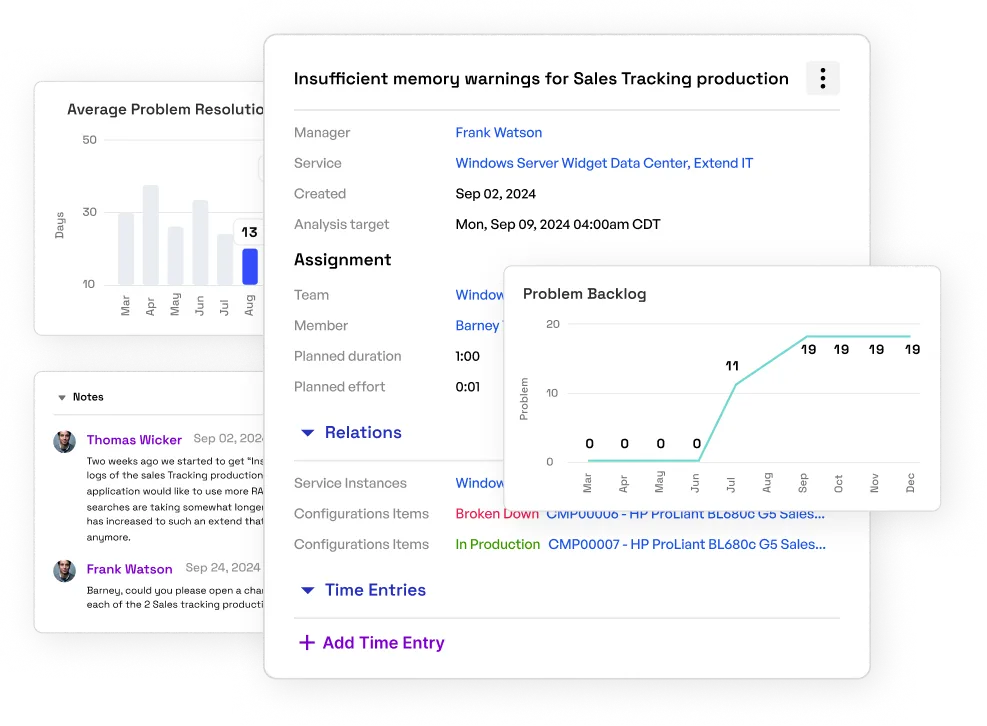
The ITSM market is crowded with platforms that over-promise on AI and under-deliver on time-to-value. Most require months of professional services, expensive module licenses, and ongoing customization just to maintain what was promised at contract signing.
Xurrent is built differently. Configuration over customization means your team controls the platform—not the other way around.


ServiceNow delivers enterprise depth—at enterprise cost and enterprise implementation timelines. Jira Service Management works well for small dev-centric teams but loses coherence at scale across IT and business departments. Freshservice moves fast but requires third-party tools the moment incident management or cross-department ESM enters the picture.
Xurrent delivers the full platform—ITSM, ESM, IMR, AI, and Status Pages—without the module maze, the implementation marathon, or the annual surprise invoice.
A ticketing tool logs and tracks support requests. An ITSM platform manages the full lifecycle of IT services—incident, problem, change, request, knowledge, SLAs, and configuration management—under a single, process-driven framework. Gartner defines ITSM platforms as cohesive workflow management systems that serve as the operational system of record for IT. Xurrent covers all 19 ITIL 4 certified practices out of the box, including capabilities that basic ticketing tools don't support at all: automated postmortems, AI-driven knowledge generation, SLA/SLO tracking, and cross-department ESM.
The right ITSM platform depends on four factors: ITIL practice coverage, AI maturity, time-to-value, and total cost of ownership including hidden module fees. Gartner Peer Insights, G2, and Info-Tech rankings consistently surface ServiceNow, Jira Service Management, Freshservice, and Xurrent as leading options. Xurrent differentiates on go-live speed (as little as 4 weeks), native AI without add-on licensing, and a single platform that covers ITSM, ESM, IMR, and Status Pages without separate contracts. Use a requirements checklist mapped to your ITIL practices, team size, and integration needs—then score each vendor against deployment timeline and ongoing admin overhead, not just feature lists.
Xurrent supports 19 certified ITIL 4 practices out of the box, including Incident Management, Problem Management, Change Enablement, Release Management, Request Fulfillment, Knowledge Management, Service Level Management (SLAs/SLIs/SLOs), Service Catalog, and Configuration Management. Pre-built templates and policies activate these practices immediately—no custom development required. Xurrent holds formal ITIL tool vendor accreditation, which means the platform has been independently verified against ITIL standards, not just self-certified.
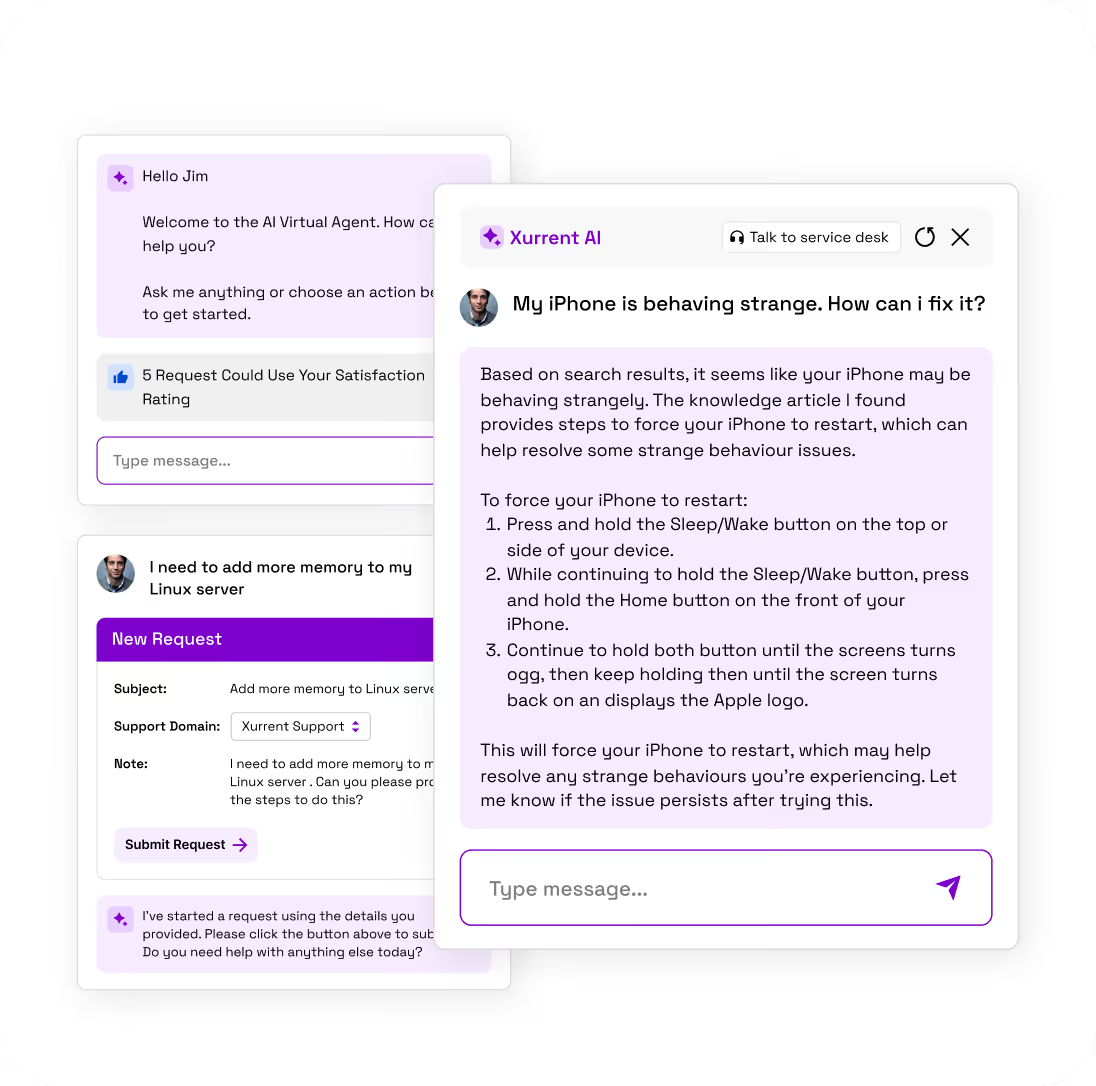
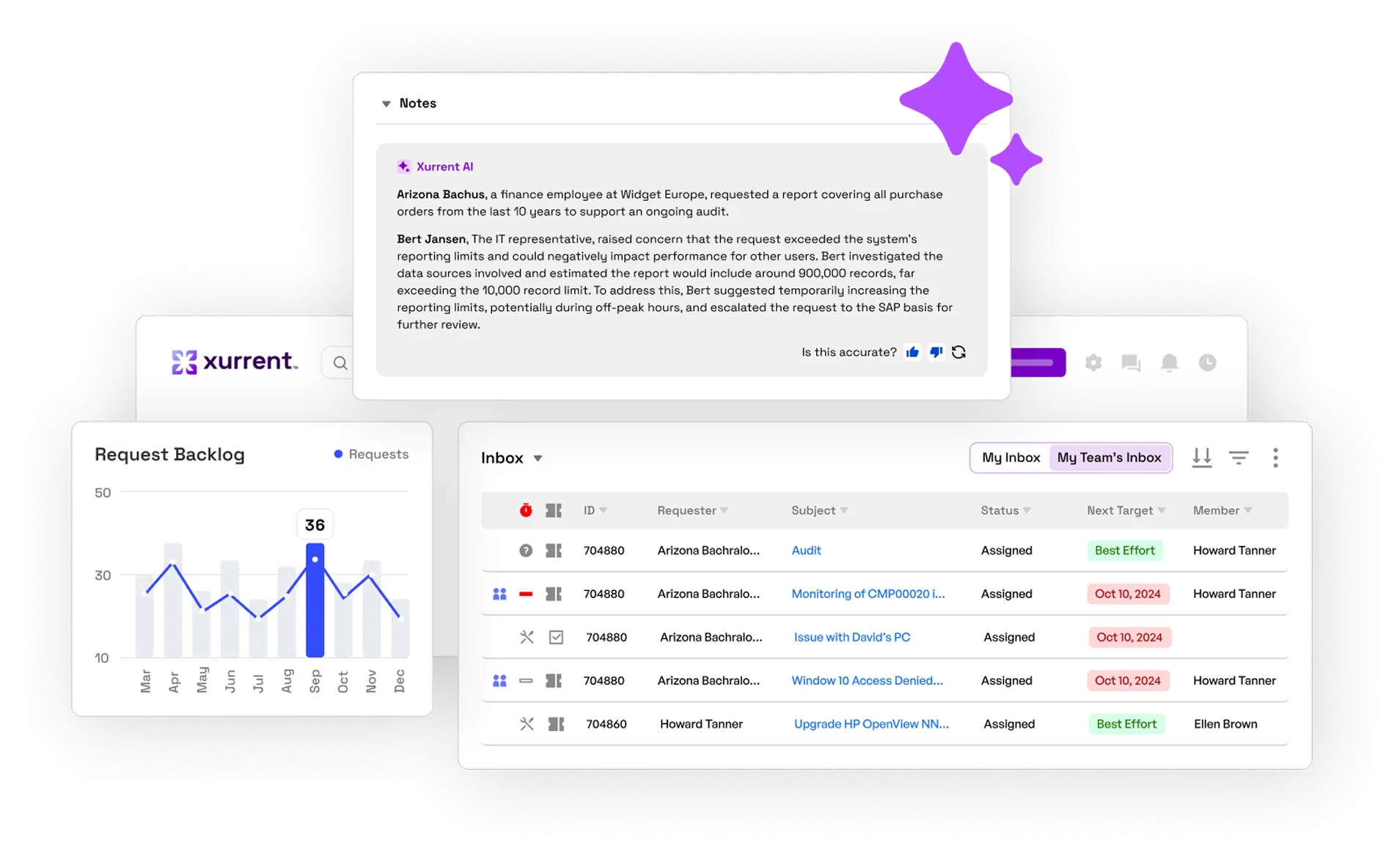
Xurrent's Sera AI operates inside ticketing and workflow layers, not as a separate chatbot. It classifies incoming tickets by intent, routes them to the correct team without manual triage, and drafts knowledge articles from resolved tickets automatically. The virtual agent handles Tier-1 requests using real context from the knowledge base and ticket history—reducing Tier-1 volume without requiring agents to train or maintain it manually. AI interactions stay inside your environment via AWS Bedrock-based isolation; your data is never used to train external models. The measurable outcome: 80% fewer misrouted tickets and significantly faster average handle time from day one.
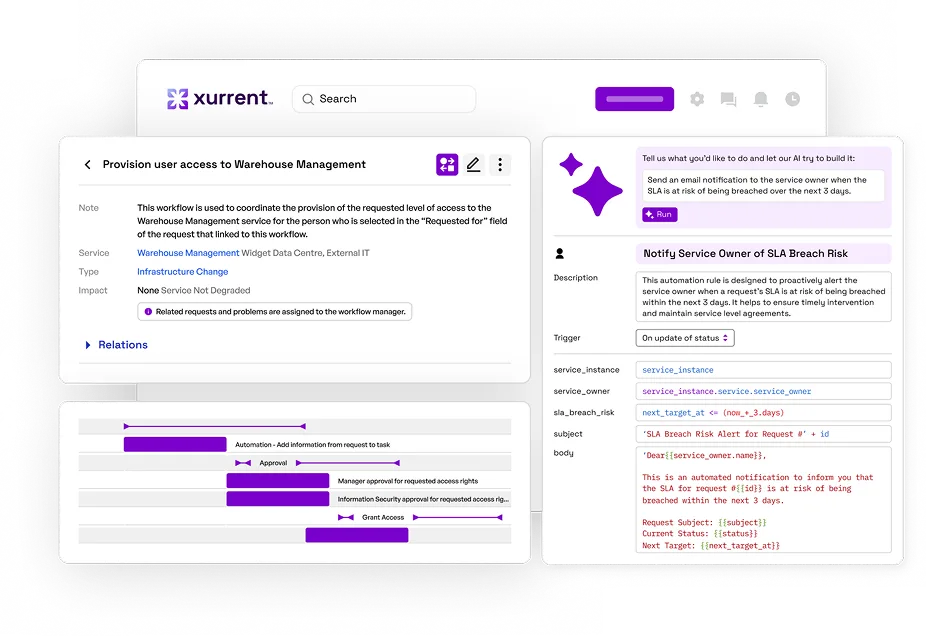
Most legacy ITSM implementations run 6–18 months and require dedicated professional services teams to configure, customize, and maintain. Xurrent is built on configuration, not customization—low-code and no-code workflows mean your team controls setup without writing code or hiring consultants. Most customers go live in as little as 4 weeks. Xurrent ships with pre-built ITIL workflows, a native virtual agent, AI, and ESM included by default, so there's no phased module rollout to plan. One-click API-first connectors for identity, monitoring, HRIS, chat, and cloud tools keep your existing stack integrated from day one.
You've seen what modern ITSM looks like. Nineteen certified ITIL practices, AI that routes and resolves without manual intervention, ESM across every department, and a go-live timeline measured in weeks—not quarters. EMA's latest research confirms what leading IT and operations teams are already proving in production.